Some of the most interesting creative work I’ve done has involved helping highly technical companies explain sophisticated products and services in a way people can immediately understand and connect with.
The expertise behind those businesses is often remarkable. Advanced technologies, specialized systems, complex operational processes, years of innovation. The thinking is deep, the products are valuable, and the people behind them genuinely know their craft. The challenge is shaping all of that expertise into communication that feels clear, intuitive, and human.
At some point during these conversations, I almost always come back to the same idea: people only need to know what time it is. They don’t need to know how to build the wristwatch.
That thought sits at the center of a surprising amount of effective marketing. The people building the product absolutely need to understand every layer of complexity behind it because that depth is often what makes the product valuable in the first place. But audiences approach the conversation differently. They want to understand what the product does, why it matters, and what changes because it exists. They are looking for clarity before complexity.
"People only need to know what time it is. They don’t need to know how to build the wristwatch."
That is where creative leadership becomes incredibly valuable, and where active listening becomes one of the most important parts of the process.
When I sit down with subject matter experts, engineers, consultants, or founders, I’m not looking for polished marketing language right away. I’m listening for how they naturally think about the product, what problems they keep returning to, what frustrations they solve, and what excites them about the work they do. Somewhere inside those conversations, there is usually a much clearer human story trying to emerge.
Experts compress information without realizing it. They skip steps because the logic feels obvious to them after years of working inside the industry. They reference systems, terminology, and workflows they’ve lived with for so long that they no longer recognize how unfamiliar those ideas might sound to someone hearing them for the first time.
The audience experiences things differently. They are trying to understand the bigger picture first. What becomes easier? Faster? More efficient? What problem disappears because this product or service exists?
That shift in perspective changes the entire creative process because now the goal is no longer to explain everything. The goal is to create understanding.
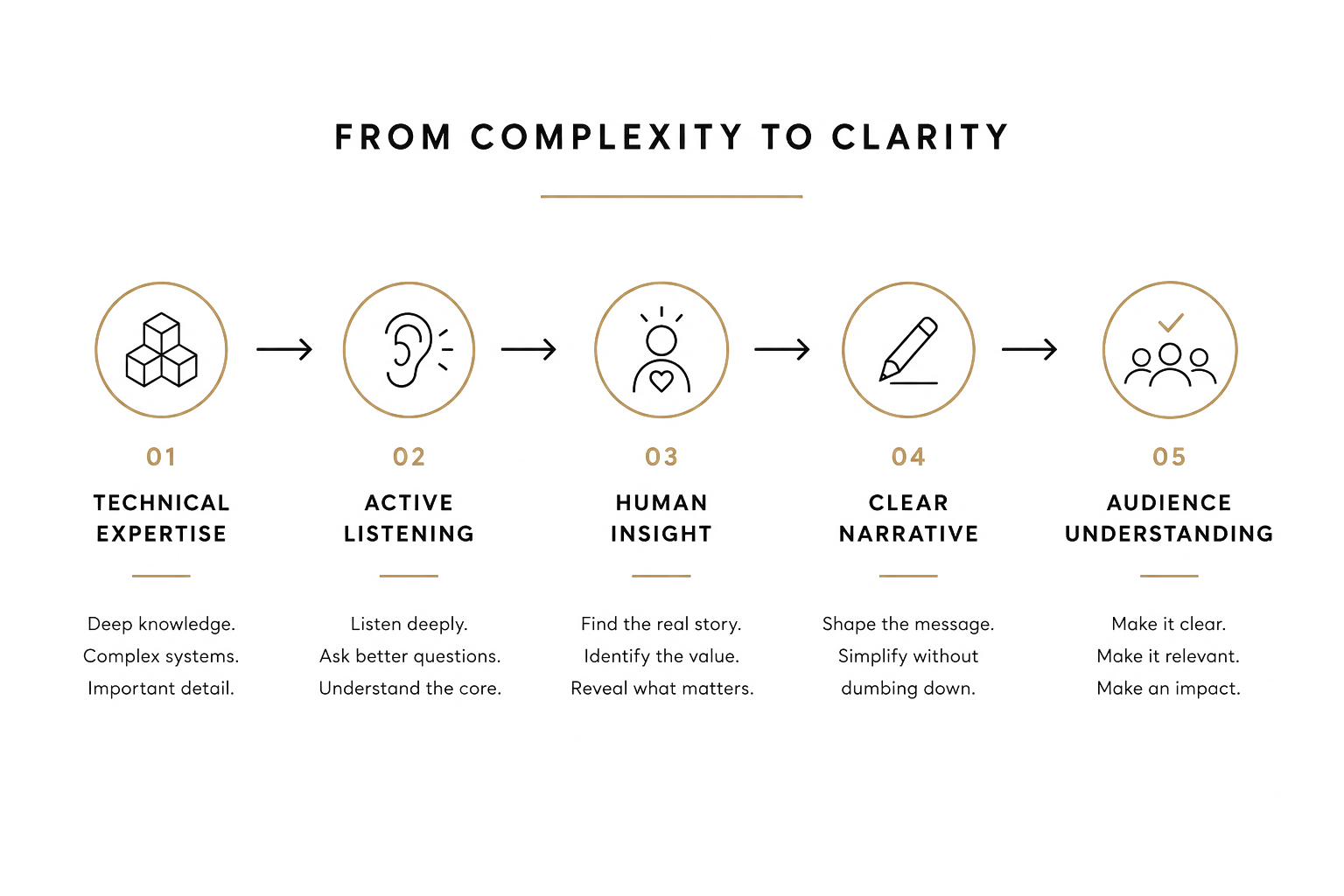
Usually there is a moment in the conversation where the complexity suddenly gives way to clarity. It might be a sentence, an analogy, or a practical outcome that reframes the product in a way people can immediately connect with. Once that happens, everything else starts aligning around it. The messaging sharpens, the visuals become more intentional, and the communication starts flowing naturally because there is finally a clear entry point into the story.
That becomes especially important in video work, where pacing, structure, and storytelling determine whether people stay engaged long enough to understand the value being presented. A strong piece of creative for a technical product should feel intuitive to the audience even when the strategy behind it is incredibly detailed. Sometimes the breakthrough comes from simplifying the sequence of information. Sometimes it comes from a visual metaphor that suddenly makes an abstract concept understandable. Sometimes it simply comes from removing unnecessary detail so the core message has room to breathe.
I’ve sat in meetings where hours of technical discussion eventually distilled into a single line that became the foundation for an entire campaign because everyone in the room suddenly understood the product more clearly.
That is the part of creative direction people often overlook. The work goes far beyond aesthetics. It requires interpretation. You are taking deep expertise and translating it into something another human being can absorb quickly and connect with emotionally.
That takes empathy, strategic thinking, and restraint.
Good creative work does more than attract attention. It creates understanding.